MANUFACTURING POLARIZING (PBS) CUBES: KEY STEPS AND OVERVIEW
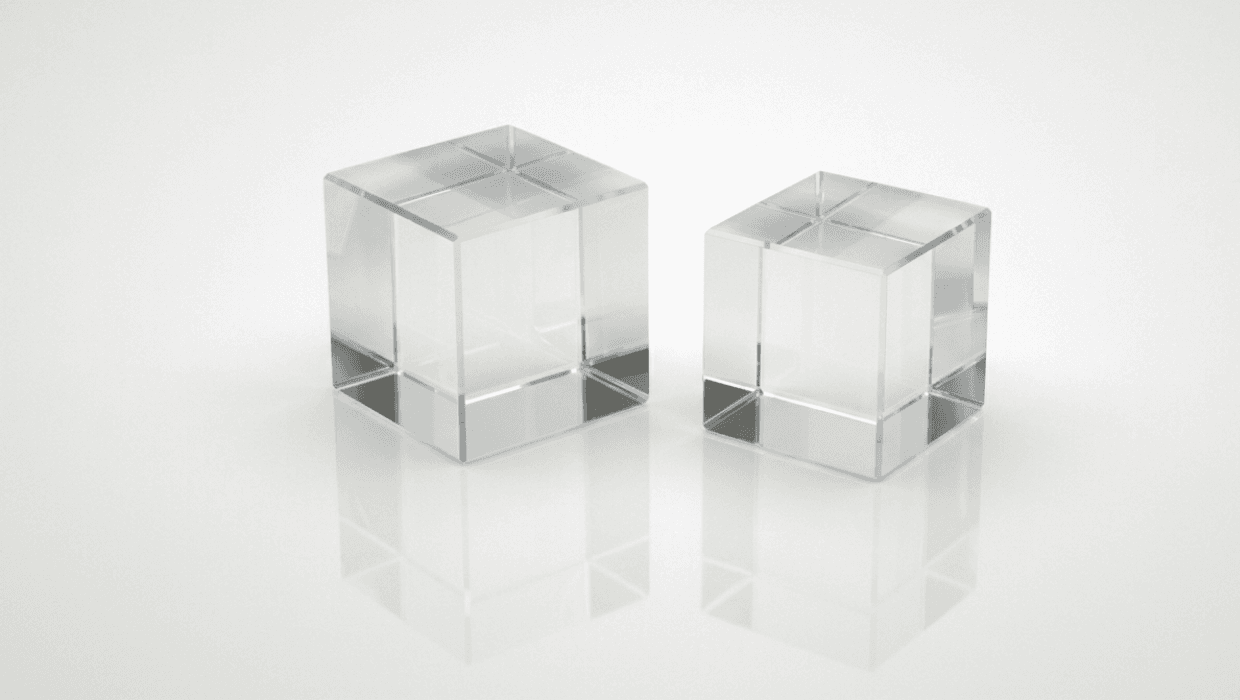
Alien Photonics overviews the key steps of polarizing beamsplitter (PBS) cubes production – from material to application.
Choosing right material for PBS cube
Several factors are to be considered while selecting the material for PBS cube. However, the first question to consider - whether you truly need PBS cube? In some applications like beam combining, Alien Photonics offers dichroic mirror as an alternative. Very often thin film plate polarizers can be used as a substitute.
Application wavelength
While standard PBS cubes typically produced form:
- UVFS (for UV applications)
- N-BK7 for visual and cost-effective solutions
- IR materials for infrared applications
Alien Photonics will advise you on the best material for your application. Contact us for more information.
Handling and cleaning
It is important to consider how cubes would be handled - generally some materials are softer than others. Also, different materials can react differently to cleaning agents.
Polishing prisms for PBS cubes
Once material is ready - it is sliced and polished. The optical polishing is done on all working surfaces.
Surface quality - scratches and digs
Depending on application the surface quality is chosen. Standard Alen Photonics PBS cubes are typically 40-20 S-D up to 10-5 S-D for UV, and lower (e.g. 60-40 S-D) for difficult to polish materials and infrared applications. More about surface quality in Alien Photonics surface quality guide
Surface Flatness and wavefront distortion
PBS cubes typically transmit P polarization and reflect S polarization. Thus, hypotenuse interface is extremely important as it must ensure that both reflected and transmitted beam components would be distorted as minimally as possible. Alien Photonics specifies both reflected and transmitted wavefront distortion of at least λ/4 @ 632.8 nm for standard cubes, but also better values (λ/8 to λ/10) for precision PBS cubes.
PBS coating and AR coating
When deciding on the right [thin film coating] few factors need to be considered: LIDT, spectral range, transmission and reflection values.
Hypotenuse coating, LIDT, spectral parameters
In the main interface - Hypotenuse - polarizing beamsplitter coating is applied, ensuring the required extinction ratio and damage threshold. To coat High power cubes other coating materials are used than standard cubes. While broadband and multiband PBS sometimes require additional design.
Enter and exit surfaces
On the enter and exit surfaces anti-reflective (AR) coating is applied to minimize the light loss. Overall, 5 coatings are applied on single cube: 4 AR coatings and 1 polarizing beamsplitter coating. This makes the component more complex when comparing to its “cousin” thin-film polarizer plates. You can learn more about the differences between PBS cube and TFP plate can be found at Alien Photonics comparison guide.
Combining - glue or optical contact?
One of the most important decisions heavily impacting the performance and price is how prisms for PBS cube will be combined. Optical contact is typically used for precision cubes when high LIDT and contrast is expected. Optical adhesives - less expensive option. You can check Alien Photonics guide comparing glue and optical contact in optical cubes.
Quality assurance and inspection
Once cubes are produced the quality inspection is done to ensure critical parameters. Final testing of dimensions, moving to surface parameters such as flatness, polishing quality and spectral parameters - transmission and reflection. Certificate of Compliance (COC) or Quality Assurance (QA) card is issued to confirm the specifications.
Packing
During transportation all sides must be protected. Alien Photonics cubes are packed either in molded forms, special paper or custom plastic boxes, depending on the customization level, and overall need for extensive protection.
Final words
Polarizing beamsplitter cubes are relatively complex components that could be used in beam combining and beam splitting. PBS cubes can be glued or optically contacted. Lots of variations from low power PBS to high power PBS, to broadband PBS make them quite universal polarizers and one of Alien Photonics key products for laser applications.